VFD Panels for Energy-Efficient Motor Control in Global Industries
Electric motors are used everywhere in modern industry. They run pumps, fans, conveyors, compressors, mixers, cooling towers, and many other machines. But operating every motor at full speed all the time can waste electricity and increase stress on equipment.
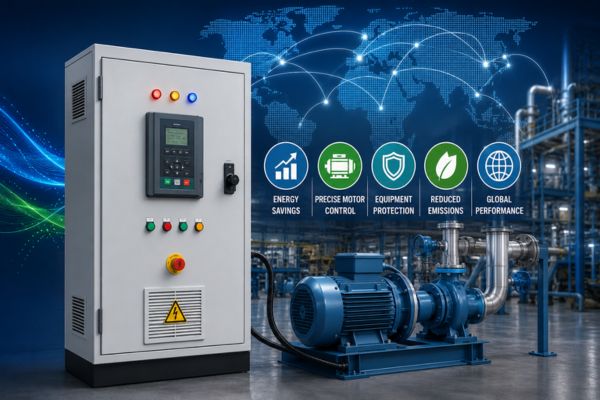
This is why Variable Frequency Drive panels are becoming an important part of modern industrial projects. A properly designed VFD panel controls motor speed according to actual process demand. For international projects, working with an experienced VFD Panel exporter also helps buyers get a system designed for their voltage, operating environment, automation requirements, and industrial application.
Why Industries Are Moving Toward VFD-Based Motor Control
Traditional motor control methods often run motors at a fixed speed. In many applications, however, full motor speed is not required throughout the day.
Consider a cooling fan in a manufacturing plant. During periods of lower heat load, the fan may only need to operate at reduced speed. Running it continuously at full capacity uses unnecessary power.
A VFD allows the motor speed to change according to actual demand.
This can help industries:
- Reduce unnecessary electricity use
- Control motor speed accurately
- Improve process performance
- Reduce mechanical shock during starting
- Lower stress on belts and couplings
- Improve pump and fan control
- Reduce maintenance requirements
- Automate motor operation
These advantages make VFD panels useful for both new industrial plants and modernization projects.
How VFD Panels Help Improve Energy Efficiency
A VFD controls the frequency and voltage supplied to an electric motor. By changing the frequency, it can increase or decrease motor speed based on process requirements.
This is especially useful for variable-load equipment such as pumps and fans.
For example, a water system may not need full pump flow throughout the day. Instead of running the pump at maximum speed and controlling flow through a valve, the VFD can reduce the actual motor speed.
The same idea can be used for ventilation fans, cooling towers, HVAC systems, and other equipment.
This demand-based control is one reason buyers increasingly look for an experienced VFD Panel exporter when planning energy-efficient industrial projects.
What Global Buyers Should Check Before Ordering a VFD Panel
Export projects require more planning than simply choosing a drive according to motor horsepower.
Different countries and industries may have different electrical supplies, operating conditions, safety requirements, and automation systems.
Supply Voltage and Frequency
One of the first things to confirm is the available electrical supply.
A panel designed for one voltage or frequency should not automatically be assumed suitable for another country.
The buyer should provide details such as:
- Incoming voltage
- Supply frequency
- Number of phases
- Motor voltage
- Motor power rating
- Full load current
- Starting conditions
- Required operating speed
These details help the panel designer select the correct VFD and protection system.
Motor Load Type Is Equally Important
Selecting a VFD only according to motor kW or HP is not always enough.
The type of load also matters.
Pumps and fans generally behave differently from crushers, mixers, conveyors, and heavy material-handling systems. Some machines require high starting torque, while others operate with changing loads.
A professional VFD panel supplier should understand:
- Variable torque loads
- Constant torque loads
- Starting torque
- Overload requirements
- Acceleration time
- Deceleration time
- Continuous operating conditions
Correct selection helps improve both motor performance and drive reliability.
VFD Panel Cooling for Hot Industrial Locations
Heat is one of the main factors that can affect electronic equipment.
VFDs generate heat during operation. If that heat is trapped inside the enclosure, the drive may experience higher temperatures or frequent trips.
Panel design should therefore consider:
- VFD heat generation
- Panel size
- Ventilation
- Cooling fans
- Air filters
- Ambient temperature
- Installation location
- Distance between components
Projects installed in hot, dusty, humid, or demanding industrial environments may need different enclosure and cooling arrangements.
When choosing a VFD Panel exporter from India, global buyers should clearly share site conditions before finalizing the design.
Why Harmonics and Electrical Noise Matter
VFDs are electronic power devices, so their installation requires proper attention to electrical quality.
Depending on the application, the system may require components such as line reactors, filters, properly sized cables, correct earthing, or shielded control wiring.
Poor installation practices can sometimes create electrical noise that affects nearby instrumentation or communication systems.
Good panel engineering separates power and control wiring properly and follows correct earthing practices.
For plants using PLCs, sensors, automation systems, and digital networks, this becomes even more important.
Smart VFD Panels for Industrial Automation
Modern factories are becoming more connected.
A VFD panel can now be part of a larger automation system rather than working as a separate motor controller.
Depending on the project, communication may be required with:
- PLC systems
- SCADA
- Building Management Systems
- Remote monitoring systems
- Industrial Ethernet networks
- Process controllers
Operators can then monitor motor speed, running status, faults, alarms, current, and other operating information.
This makes troubleshooting easier and gives maintenance teams better control over equipment.
Industries Using VFD Panels Worldwide
VFD panels can be used in many sectors where motors need controlled speed and reliable operation.
Common applications include:
Water and Wastewater Plants
VFD panels control pumps according to pressure, flow, or tank levels.
HVAC Systems
They are used for chilled water pumps, cooling tower fans, AHUs, and ventilation systems.
Manufacturing Plants
VFDs control conveyors, mixers, machine drives, pumps, and process equipment.
Food and Beverage Industry
They provide controlled motor speed for processing, packaging, mixing, and material handling.
Chemical and Pharmaceutical Plants
VFD panels support controlled operation of pumps, agitators, ventilation systems, and process machinery.
Cement and Material Handling Plants
They can be used for conveyors, fans, crushers, feeders, and other heavy industrial equipment.
What Makes a Reliable VFD Panel Exporter?
International buyers should evaluate more than panel price.
A reliable supplier should be able to understand project specifications and provide a panel according to the actual operating requirement.
Important capabilities include:
- Customized panel engineering
- Proper VFD selection
- Suitable switching and protection devices
- Organized power and control wiring
- Correct cooling arrangement
- Clear component identification
- Functional testing
- Electrical drawings
- Technical documentation
- Export-ready packing
Buyers should also share the motor list, single-line diagram, application details, communication requirements, and installation environment during the enquiry stage.
This reduces design changes later in the project.
Ahmedabad and India as a Source for Industrial VFD Panels
Ahmedabad, Gujarat has a strong industrial base covering electrical engineering, machinery, process equipment, pharmaceuticals, chemicals, textiles, water treatment, and automation.
This industrial ecosystem has created demand for customized motor control and automation panels.
Global buyers sourcing from India can look for a VFD Panel exporter in Ahmedabad that understands both panel manufacturing and real industrial applications.
The focus should always remain on engineering quality, correct component selection, testing, documentation, and long-term reliability rather than choosing a system only on initial cost.
Conclusion
Industrial energy efficiency is no longer only about purchasing efficient motors. How those motors are controlled also matters.
A properly designed VFD panel allows motor speed to follow actual process demand while improving control, reducing unnecessary mechanical stress, and supporting industrial automation.
For overseas projects, choosing the right VFD Panel exporter is especially important because voltage, frequency, motor duty, environmental conditions, communication requirements, and project specifications can differ from one country to another.
By selecting the correct VFD, protection system, enclosure, cooling arrangement, and control architecture, industries can build motor control systems that are efficient, reliable, and ready for modern automation.
- Customized panel engineering
- Proper VFD selection
- Suitable switching and protection devices
- Organized power and control wiring
- Correct cooling arrangement
- Clear component identification
- Functional testing
- Electrical drawings
- Technical documentation
- Export-ready packing
Buyers should also share the motor list, single-line diagram, application details, communication requirements, and installation environment during the enquiry stage.
This reduces design changes later in the project.
FAQs
A VFD panel is used to control the speed and operation of an electric motor by changing the frequency and voltage supplied to it. It is commonly used with pumps, fans, conveyors, compressors, and industrial machines.
Yes. VFD panels can reduce unnecessary energy use in applications where motors do not need to run at full speed continuously. Pumps and fans are common examples.
You should provide motor kW or HP, voltage, frequency, full-load current, application type, operating conditions, required speed range, automation requirements, and installation environment.
Yes. Export VFD panels can be designed according to project voltage, frequency, enclosure requirements, motor ratings, communication systems, environmental conditions, and other technical specifications.
VFD panels are widely used in water treatment, HVAC, manufacturing, pharmaceuticals, chemicals, food processing, textiles, cement plants, material handling, and infrastructure projects.
VFDs produce heat during operation. Proper ventilation or cooling helps control internal panel temperature and supports reliable operation of the drive and other electrical components.
Yes. Depending on the selected drive and communication protocol, VFD panels can exchange operating data and commands with PLC, SCADA, BMS, and other industrial automation systems.
Check the supplier’s engineering capability, VFD selection process, component quality, testing facilities, customization options, documentation, automation knowledge, export packaging, and technical support.